Tag: Cosmetic Dentistry

  • What a Hollywood Smile Actually Involves

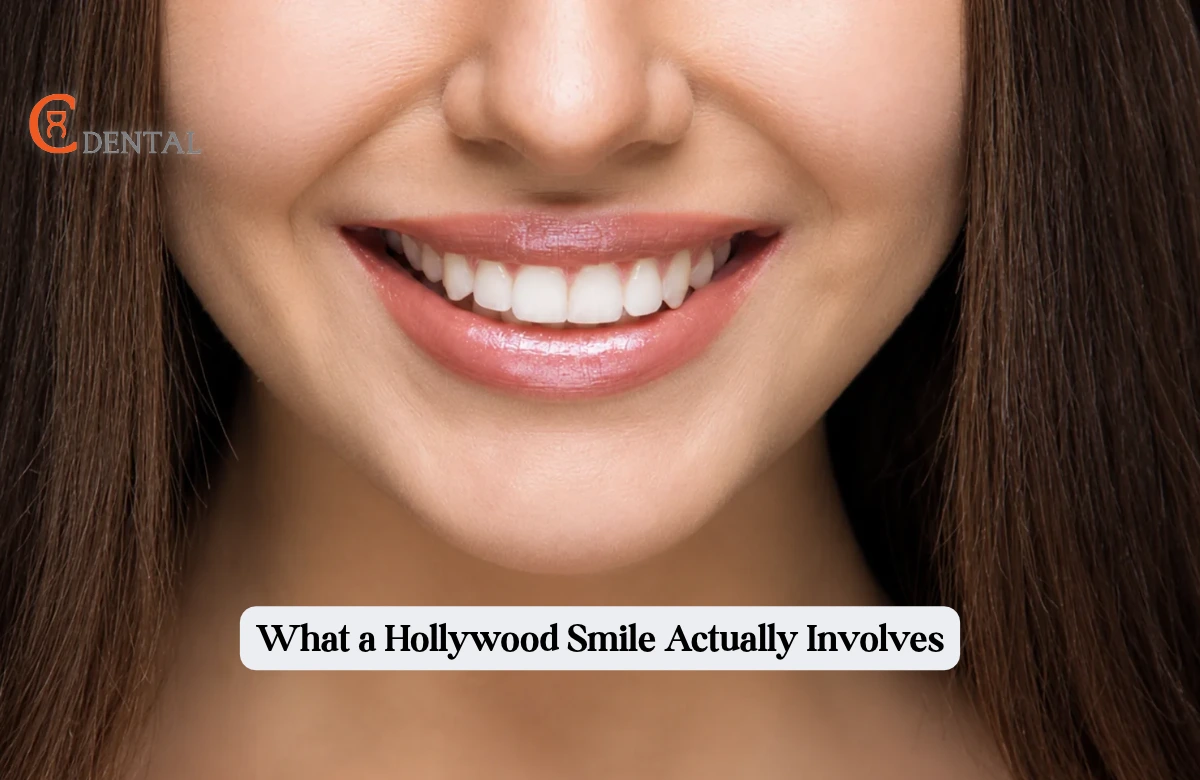
    What a Hollywood Smile Actually Involves

    “Hollywood Smile” gets thrown around a lot, on clinic websites, in ads, in casual conversation about celebrities. But ask most people what it actually involves, and the answer gets vague fast. Is it just whitening? A full set of veneers? Something else entirely?

    It’s worth clearing up, because a Hollywood Smile isn’t one specific procedure. It’s a coordinated plan, and understanding what actually goes into it makes the whole process far less mysterious.

    What a Hollywood Smile Actually Is

    A Hollywood Smile is a full smile makeover, not a single treatment. Rather than fixing one tooth or one issue, it’s a combination of cosmetic procedures planned together to create a bright, symmetrical, naturally proportioned smile, one designed around your specific face, not a generic template.

    That’s the key distinction from getting a few veneers. Veneers on their own are a spot treatment, addressing a chip, a stain, or a gap on one or two teeth. A Hollywood Smile looks at the whole picture: tooth color, shape, alignment, gum line, and how all of it works together when you smile.

    What’s Actually Included

    Depending on what your teeth need, a Hollywood Smile can combine any of the following:

    Teeth whitening. Often the first step, since it establishes the baseline shade everything else gets matched to. If whitening happens after veneers are placed instead of before, the shades won’t align properly, which is why the order matters.

    Porcelain veneers. Thin custom shells bonded to the front of your visible teeth, usually the top 6 to 10, to correct color, shape, size, and minor alignment issues all at once.

    Dental crowns. For teeth that need more than a thin veneer can offer, whether from more significant damage or a need for extra structural support, a crown covers the entire tooth rather than just the front surface.

    Gum contouring. If your gum line looks uneven or shows more gum tissue than tooth when you smile, reshaping the gum line can make a real difference in how balanced the final result looks.

    Digital Smile Design (DSD). Modern planning increasingly starts here. Using photos and digital imaging, your dentist maps out how your new smile will actually look on your face before any tooth preparation even begins, so you’re reviewing and approving a realistic preview rather than hoping for the best.

    Not every Hollywood Smile plan uses every item on this list. Your dentist builds the combination around what your teeth and smile actually need.
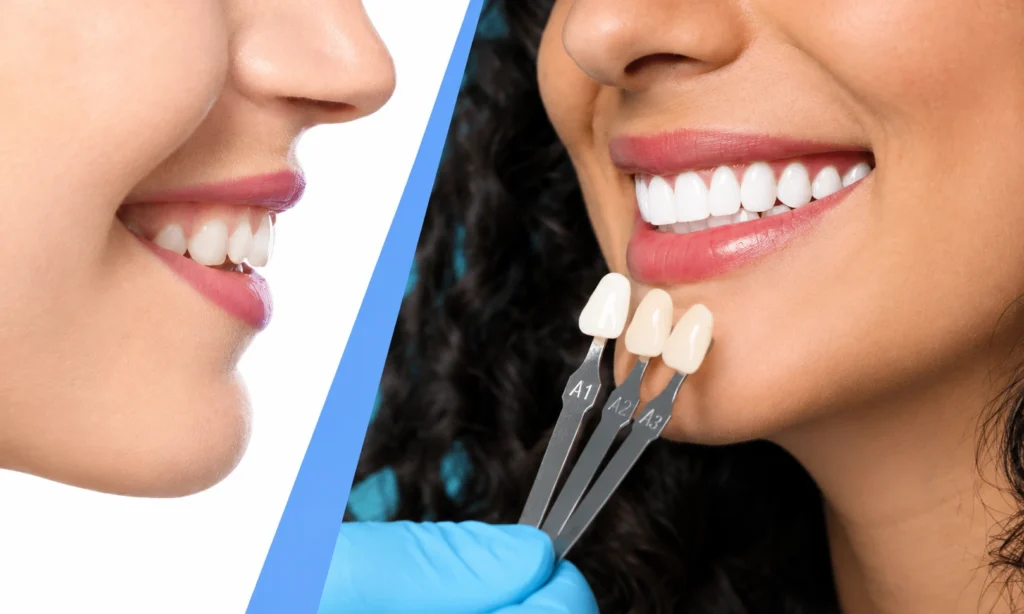
    Side-by-side comparison of a smile before and after dental veneers, showing different tooth shades using a dental shade guide.

    Hollywood Smile vs. Veneers: What’s the Real Difference?

    This comes up constantly, and it’s a fair question since veneers are usually part of a Hollywood Smile anyway.

    Veneers alone are a targeted fix. If you have one chipped tooth or a stain that whitening won’t touch, veneers on just that tooth (or a small handful) solve the specific problem.

    A Hollywood Smile is broader by design. It typically covers all your visible teeth, factors in gum line and facial symmetry, and often combines veneers with whitening or contouring rather than relying on one treatment alone. It costs more and takes more planning, but the result is a coordinated transformation rather than a single correction.

    Neither is “better” in general. If you only have one problem tooth, a full Hollywood Smile is more than you need. If you want a complete, evened-out smile across all your visible teeth, that’s exactly what it’s built for.

    What the Process Actually Looks Like

    Consultation and planning. Your dentist examines your teeth, gums, and bite, discusses what you want to change, and often uses digital smile design to show you a realistic preview of the result.

    Preparation. For veneers, this usually means a small amount of enamel removal to create a flush surface. Whitening, if included, generally happens at this stage too, before your teeth are shade-matched for the final veneers.

    Impressions and temporaries. Your dentist takes precise impressions or digital scans to have your custom veneers or crowns made, and you’ll typically wear temporary versions while the final ones are being crafted.

    Final placement. Once your permanent veneers or crowns are ready, your dentist checks the color, shape, fit, and bite carefully before bonding everything into place and polishing for that final, natural-looking finish.

    How Long Does It Take?

    This varies with how much is involved. A straightforward plan using mostly veneers and whitening might wrap up in a few visits over a couple of weeks. A more complex plan involving crowns, gum contouring, or orthodontic work beforehand takes longer, sometimes a few months, since certain steps need healing time before the next stage.

    Frequently Asked Questions

    Q: Does a Hollywood Smile look fake?

    A: Not when it’s done well. A properly planned Hollywood Smile is matched to your facial proportions, skin tone, and natural tooth shade, which is exactly what digital smile design helps avoid, an overly uniform, obviously artificial look.

    Q: Is a Hollywood Smile permanent?

    A: Porcelain veneers and crowns are considered a long-term, largely permanent change, since enamel removal isn’t reversible. Whitening and gum contouring are more temporary or gradual in comparison, and your dentist will walk you through which parts of your specific plan are permanent versus not.

    Q: How many teeth are usually involved?

    A: Most Hollywood Smile plans focus on the teeth visible when you smile, typically the upper 6 to 10 front teeth, sometimes extending to the lower arch depending on your goals.

    Q: Does it hurt?

    A: Any enamel preparation is done with local anesthesia, so you shouldn’t feel pain during the procedure itself. Mild sensitivity afterward is normal and typically settles within a few days.

    Q: How do I know what my Hollywood Smile plan should include?

    A: That’s exactly what the consultation and digital smile design step are for. Rather than guessing, your dentist evaluates your specific teeth, gums, and goals, then builds a plan around what will actually make the biggest difference for your smile.
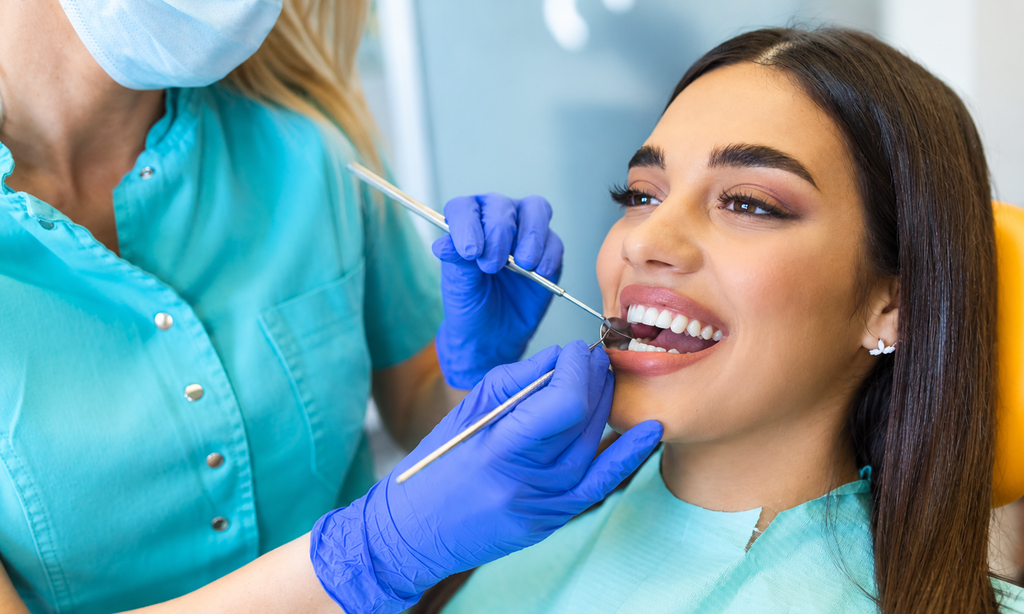
    Dentist examining a patient's teeth during a Hollywood Smile consultation at a dental clinic.

    Hollywood Smile at C Dental Clinic

    At C Dental Clinic in Al Nahda, Sharjah, a Hollywood Smile plan starts with understanding what you actually want your smile to look like, then combining the right mix of veneers, teeth whitening, and gum contouring to get there, rather than applying the same package to every patient.

    👉 Book a consultation at C Dental Clinic to find out what a Hollywood Smile plan would look like for you.

    References

    1. Cleveland Clinic — Veneers: Types, Procedure, and Care
    2. American Academy of Cosmetic Dentistry — Smile Makeover Overview
    3. Colgate Oral Care — What Is a Smile Makeover?
  • Veneers vs. Lumineers: A Real Comparison

    Veneers vs. Lumineers: A Real Comparison

    Both promise the same thing: a brighter, more even smile, fast. But “veneers” and “Lumineers” get used almost interchangeably online, which makes choosing between them harder than it should be. They’re related, not identical, and the real difference comes down to a few practical factors that actually affect how they look, how long they last, and what happens to your natural teeth along the way.

    What Each One Actually Is

    Porcelain veneers are thin custom shells, roughly 0.5 to 0.7 millimeters thick, bonded to the front of your teeth to cover chips, stains, gaps, or uneven shapes. To make room for that thickness and create a flush, natural-looking fit, your dentist removes a small amount of enamel before bonding them in place.

    Lumineers are a specific, patented brand of ultra-thin porcelain veneer, made from a material called Cerinate. At roughly 0.2 to 0.3 millimeters, they’re noticeably thinner, often compared to the thickness of a contact lens. That thinness is the whole point: Lumineers usually need little to no enamel removal at all, which is why they’re often called “no-prep veneers.”

    In short, Lumineers are a type of veneer, not a completely separate category. The difference that matters comes down to thickness, and everything else follows from that.

    The Four Differences That Actually Matter

    1. How much of your tooth gets prepared Traditional veneers require light enamel reduction to fit properly and sit flush against your tooth. Lumineers, because they’re so much thinner, usually skip this step entirely. That makes Lumineers a more conservative option if keeping your natural enamel intact matters to you, and in many cases the process is reversible, since there’s less permanent tooth alteration involved.

    2. How natural they look on discolored teeth This is where thickness works against Lumineers a little. Their thinness makes them slightly translucent, which is great for a subtle look but means they’re not always the strongest option for covering significant discoloration or a noticeably dark tooth underneath. Traditional veneers, being thicker and more opaque, generally do a better job fully masking heavier staining or damage.

    3. How long they last Both options hold up well with proper care, but traditional veneers generally edge ahead on pure durability, typically lasting 10 to 15 years or more, compared to roughly 8 to 12 years for Lumineers. The gap isn’t huge, but if you grind your teeth or want the longest possible lifespan from the investment, thicker, traditional veneers tend to hold up better under that kind of pressure.

    4. What it costs Lumineers are often slightly less expensive upfront, mainly because the procedure involves less prep work and chair time. That said, the price ranges for both genuinely overlap quite a bit depending on the case, and the “cheaper” option today can even out over time if it needs replacing sooner than a traditional veneer would. Cost shouldn’t be the only factor in the decision.

    Which One Actually Fits You?

    A few rough guidelines, though your dentist will always confirm this properly based on an in-person exam:

    • If you have minor to moderate discoloration, small gaps, or slightly uneven teeth, and you’d prefer to keep as much natural enamel as possible, Lumineers are often a strong fit.
    • If you’re dealing with more significant staining, chips, or want maximum durability and coverage, traditional porcelain veneers usually deliver a more reliable, longer-lasting result.
    • If you grind your teeth at night, thicker, traditional veneers generally hold up better against that repeated pressure than the thinner Lumineers option.
    • If reversibility matters to you, meaning you’d like the option to remove them later without permanently altering your teeth, Lumineers’ no-prep approach keeps that door open in a way traditional veneers don’t.

    Neither option is objectively “better” across the board. The right choice depends on what your teeth actually need and what you personally value, natural enamel preservation, maximum durability, or the lightest possible touch.

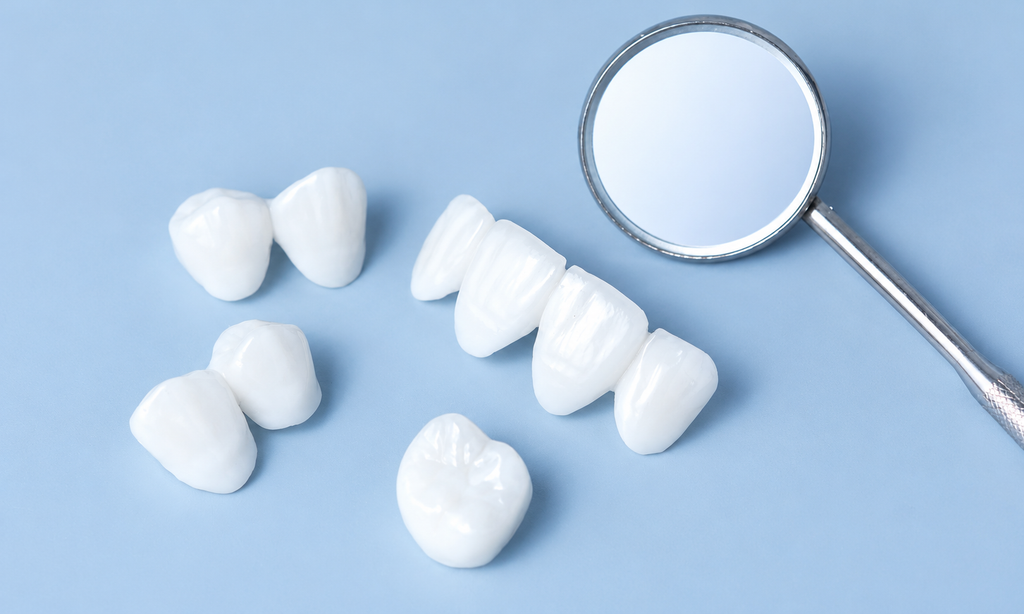
    Porcelain dental crowns displayed beside a dental mirror on a blue background.

    What Both Options Have in Common

    It’s worth remembering how much overlap exists too. Both are custom-made from porcelain, both are color-matched to blend naturally with your smile, both require a proper consultation and impression process before placement, and both need the same basic care afterward, good oral hygiene, avoiding using your teeth as tools, and regular checkups to keep an eye on their condition over the years.

    Frequently Asked Questions

    Q: Can I switch from Lumineers to traditional veneers later if I change my mind?

    A: Often, yes, since Lumineers require minimal to no enamel removal, there’s usually more natural tooth structure left to work with if you want to upgrade to traditional veneers down the line.

    Q: Do Lumineers feel different in my mouth?

    A: Most people describe them as feeling very close to natural teeth, sometimes even less noticeable than traditional veneers at first, since there’s less change to the tooth’s original shape and thickness underneath.

    Q: Which option is more painful to get?

    A: Neither should cause significant pain. Traditional veneers may involve a small amount of local anesthetic for the enamel-reduction step, while Lumineers, requiring little to no reduction, are often placed with little to no anesthesia needed at all.

    Q: Can either option fix crooked teeth?

    A: Both can visually improve mild misalignment by adjusting the shape and angle of the visible tooth surface, but neither actually moves teeth. Significant crowding or bite issues usually need orthodontic treatment first.

    Q: How do I know which one is right for my specific teeth?

    A: This really does need an in-person exam. Your dentist checks your enamel condition, the extent of discoloration, your bite, and your goals before recommending one over the other, rather than a generic rule applying to everyone.

    Veneers and Lumineers at C Dental Clinic

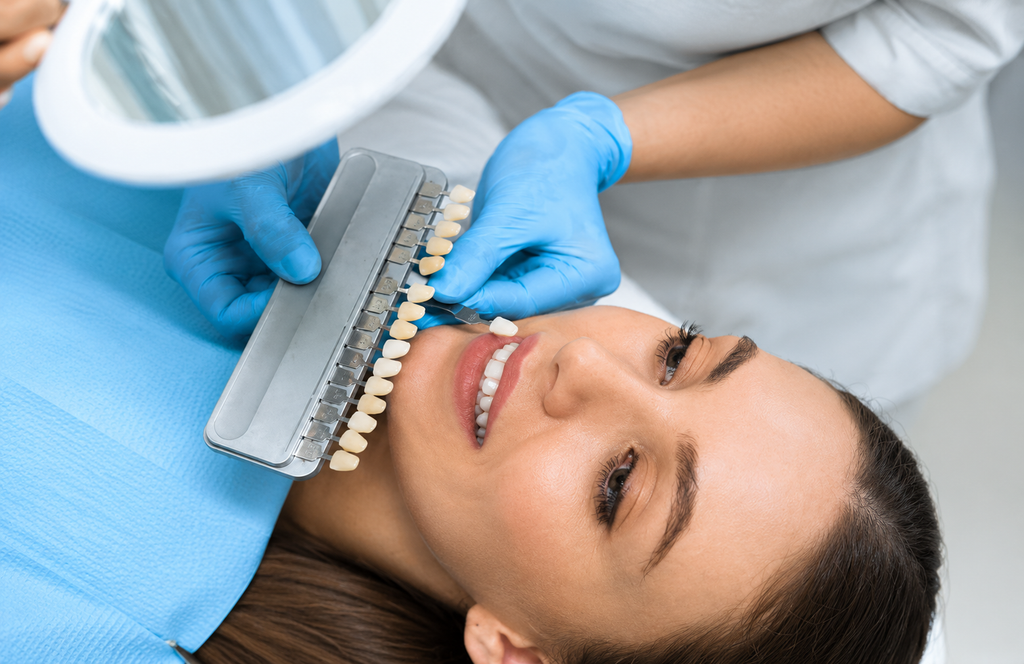
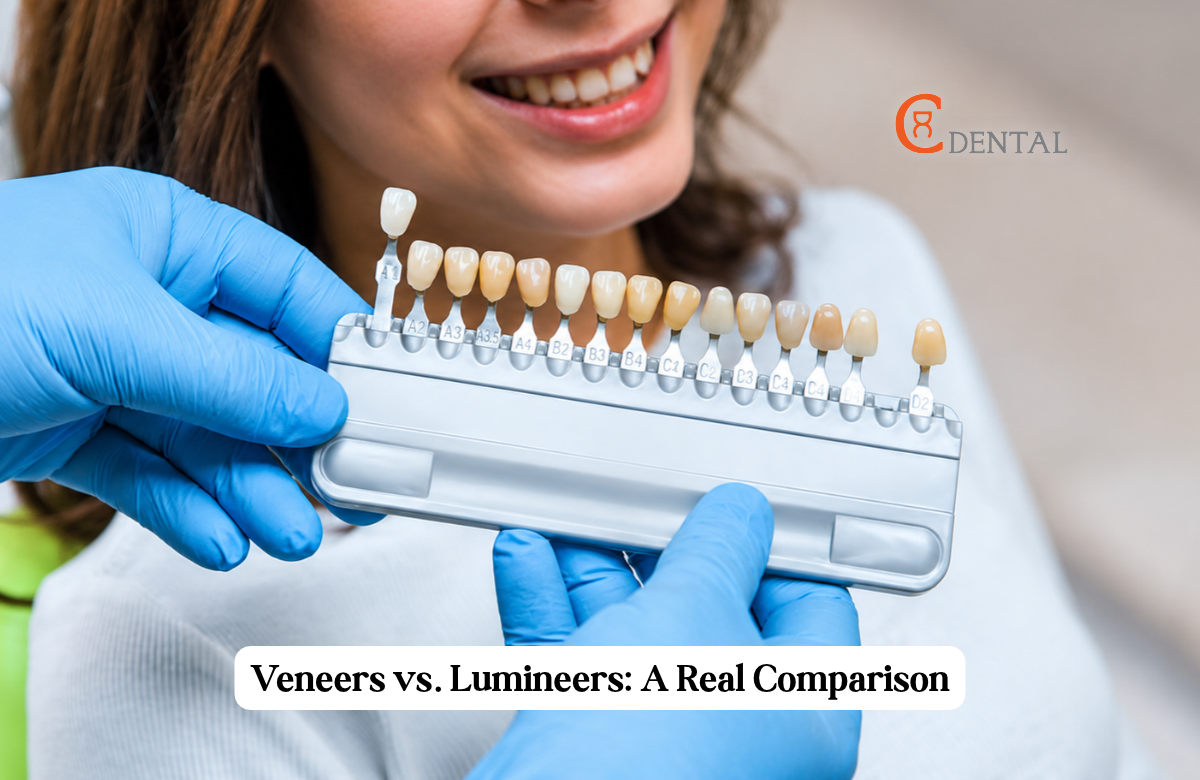
    Dentist comparing tooth shades with a dental shade guide against a patient's teeth during cosmetic dental treatment.

    At C Dental Clinic in Al Nahda, Sharjah, choosing between porcelain veneers and Lumineers starts with a proper look at your teeth, not a one-size-fits-all recommendation. We’ll walk you through exactly what each option means for your specific case, so the decision actually fits your smile and your priorities.

    👉 Book a consultation at C Dental Clinic to find out which option is right for you.

    References

    1. Cleveland Clinic — Veneers: Types, Procedure, and Care
    2. American Academy of Cosmetic Dentistry — Veneers and Lumineers Explained
    3. Colgate Oral Care — Lumineers vs. Veneers: What’s the Difference