Tag: tooth replacement

  • Dentures 101: Full, Partial, and What Actually Fits Your Life

    Dentures 101: Full, Partial, and What Actually Fits Your Life

    Losing teeth, whether from decay, gum disease, or an injury, brings up a practical question fast: what actually replaces them? Dentures have been doing that job for over a century, and modern ones look nothing like the stiff, obviously-fake versions people picture. The real question isn’t whether dentures work. It’s which type actually fits your situation, and what living with them day to day really involves.

    Full Dentures vs. Partial Dentures: The Core Difference
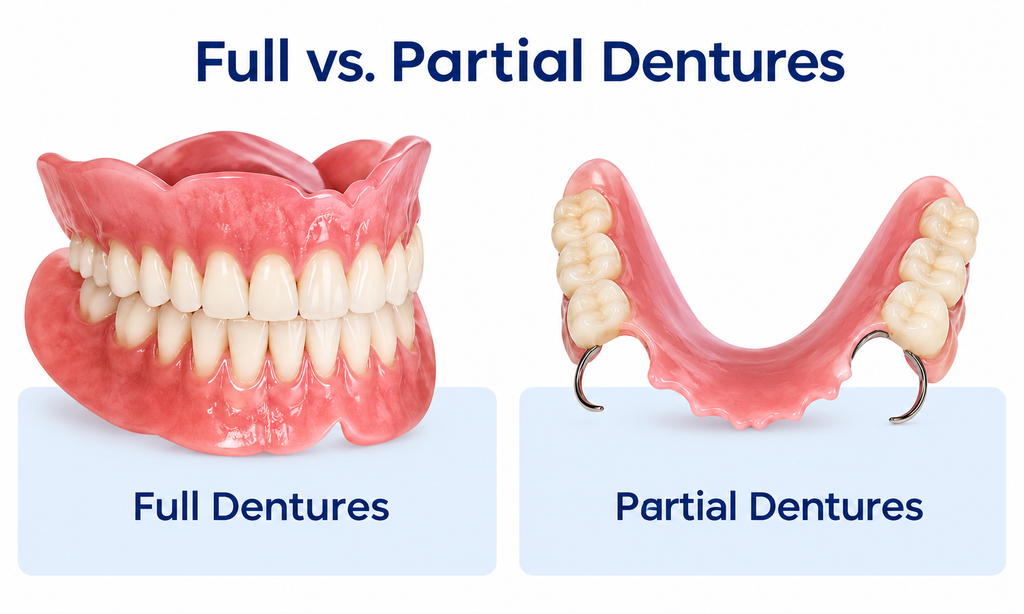
    Full dentures replacing a whole arch beside a partial denture with metal clasps for remaining natural teeth

    The choice between full and partial dentures comes down to one simple factor: how many of your natural teeth remain, and how healthy they are.

    Full dentures replace an entire arch, upper, lower, or both, when no natural teeth remain in that arch. They rest directly on your gums, held in place by suction and the natural contours of your mouth, sometimes with the help of an adhesive.

    Partial dentures fill in gaps when you still have healthy natural teeth worth keeping. They attach to those remaining teeth using small clasps or precision attachments, filling the missing spaces while leaving your healthy teeth in place and functioning.

    Neither option is automatically “better.” Your dentist bases the recommendation on the condition of whatever teeth you still have, not a general preference for one type over the other.

    Full Dentures: What to Expect

    If you’re losing all your teeth in an arch, either already gone or scheduled for extraction, your dentist typically waits a few weeks after extraction for your gums to heal before fitting a conventional full denture. In some cases, an immediate denture gets placed the same day as extraction, so you’re never without teeth, though it usually needs adjusting later as your gums finish healing and change shape.

    The fitting process involves several appointments: an exam, impressions of your gums, a bite registration to capture how your jaws align, and a tooth-shade selection to match your natural coloring. Your dentist reviews the fit and adjusts it before finalizing.

    The adjustment period genuinely takes time, usually a few weeks, sometimes longer for the lower arch specifically, since lower dentures have less surface area to grip onto and tend to feel less stable at first. Expect some soreness, increased saliva production, and speech that feels slightly off initially. This settles down with practice. Reading out loud for a few minutes a day speeds up the adjustment to speaking clearly again.

    Partial Dentures: What to Expect

    A partial denture works differently because it has something to hold onto, your remaining natural teeth. This generally makes the fitting process feel more secure from the start, and most people adjust faster than they would with a full denture, often within days to two weeks rather than a few months.

    The appliance itself consists of replacement teeth attached to a metal or flexible framework, which clips onto your natural teeth using small clasps. Depending on the design, these clasps may be slightly visible when you smile, something worth discussing with your dentist if appearance is a priority, since some partial designs minimize this more than others.

    A genuine advantage of partial dentures: keeping your remaining healthy teeth in place helps preserve your jawbone density in that area and gives your bite more natural stability than a full denture resting on gums alone.

    Comfort, Eating, and Speaking: The Practical Side

    Both types take an adjustment period, that’s simply part of wearing any removable appliance for the first time. A few practical things help regardless of which type you have:

    • Start with soft foods for the first week or two, gradually working back to your normal diet as you get used to chewing with the new appliance
    • Cut food into smaller pieces at first, and chew slowly on both sides evenly rather than favoring one side
    • Practice speaking by reading aloud, most people regain clear speech within one to two weeks
    • Expect some extra saliva production initially, this is completely normal and settles as your mouth adjusts

    If a denture ever feels genuinely painful rather than just unfamiliar, that’s not something to push through. Persistent sore spots usually mean the fit needs a quick adjustment, not that you need to simply get used to it.

    Caring for Your Dentures

    Daily care matters just as much as the fitting itself, for both types:

    • Remove and rinse your denture after eating, especially after sticky or hard foods
    • Brush it daily with a denture-specific brush and cleaner, not regular toothpaste, which can be too abrasive
    • Soak it overnight in a denture-soaking solution to keep it from drying out and losing its shape
    • If you have a partial denture, keep brushing your remaining natural teeth thoroughly, since those teeth are now doing extra work supporting the appliance and staying decay-free matters more than ever
    • Keep up with regular dental checkups so your dentist can catch fit changes early, since your gums and jawbone shift gradually over time even after the initial adjustment period

    How Long Do Dentures Last?

    With consistent care, most dentures last somewhere between five and ten years before they need replacing or relining. Full dentures on the shorter end of that range, partial dentures sometimes a bit longer, though this varies by individual. The main reason dentures eventually need replacing isn’t wear on the appliance itself, it’s that your jawbone and gums continue changing shape over the years, gradually affecting how well the original fit holds.

    Implants vs. Dentures: A Quick Note
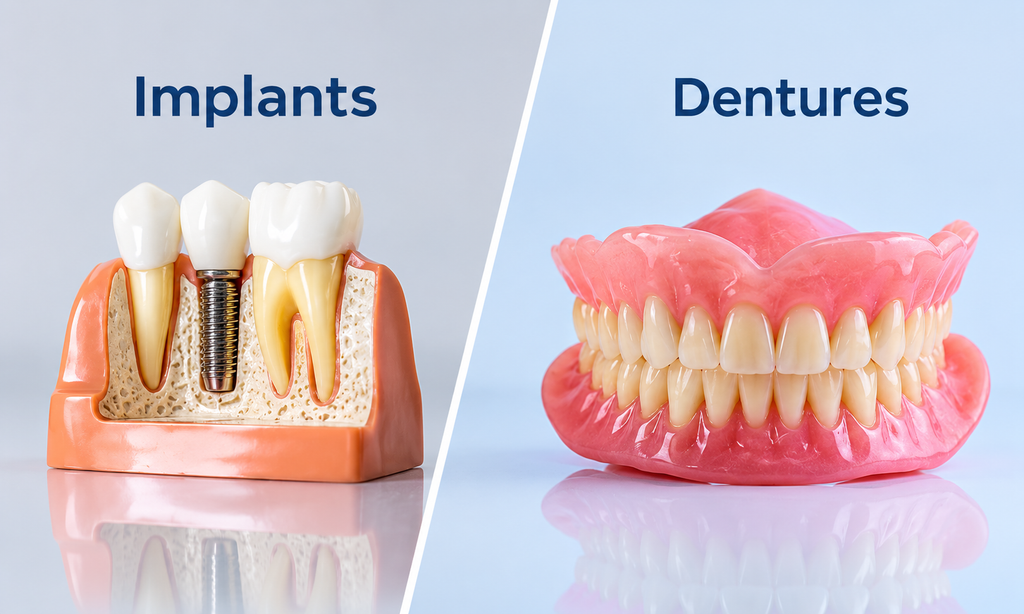
    Side-by-side comparison of a dental implant model and a set of full dentures

    Dentures aren’t the only option for replacing missing teeth. Dental implants offer a fixed, permanent alternative that doesn’t come out at night and helps preserve jawbone density more directly, since chewing pressure on an implant stimulates the bone the way a natural tooth root does. Dentures remain a strong option for many people though, particularly when cost, avoiding surgery, or replacing an entire arch at once matters more than a fixed solution. Your dentist can walk you through which fits your specific case and budget.

    Frequently Asked Questions

    Q: Will dentures look natural?

    A: Yes. Modern dentures are custom-shaded and shaped to match your natural teeth and gum color, and a well-fitted denture looks far more natural than older styles people often picture.

    Q: Can I sleep in my dentures?

    A: Most dentists recommend removing them at night to let your gums rest and to soak the denture properly, though your dentist will advise based on your specific situation.

    Q: How much do dentures cost?

    A: Cost depends on the type (full or partial), the materials used, and whether any extractions are needed first. A consultation gives you a clear, personalized estimate rather than a general figure.

    Q: What if my partial denture’s supporting tooth fails later?

    A: The partial can usually be adjusted or remade to account for the change, and in some cases it gets converted toward a full denture if enough natural teeth are eventually lost.

    Q: Can I eat normally with dentures?

    A: Yes, after the initial adjustment period. Most people return to a full, varied diet within a few weeks, starting soft and working back up to harder foods as confidence builds.

    Dentures at C Dental Clinic

    Dentist showing a denture on a tray to a smiling patient during a denture consultation at C Dental Clinics Sharjah

    At C Dental Clinic in Al Nahda, Sharjah, every denture case starts with a close look at how many teeth remain, their condition, and what actually fits your daily life, rather than defaulting to one type for everyone. Whether you need a full arch replaced or a partial to fill a few gaps, we fit and adjust each denture until it genuinely feels right.

    👉 Book a consultation at C Dental Clinic to find out which type of denture fits your situation.

    References

    1. Cleveland Clinic — Dentures: Types, Care, and What to Expect
    2. Mayo Clinic — Dentures: Getting Used to New Dentures
    3. American College of Prosthodontists — Denture Care and Facts
  • Dental Implants: What to Expect Before, During, and After

    Dental Implants: What to Expect Before, During, and After

    A missing tooth changes more than your smile. It changes how you chew, how your other teeth shift over time, and sometimes how confident you feel talking to someone up close. Dental implants exist to solve that problem properly, not just cover it up, and they’ve become the option most dentists recommend when a tooth can’t be saved.

    Still, “implant” is a word that carries a lot of anxiety. People imagine a long, painful surgery and months of uncertainty. The reality looks quite different once you understand what actually happens at each stage.

    What a Dental Implant Actually Is

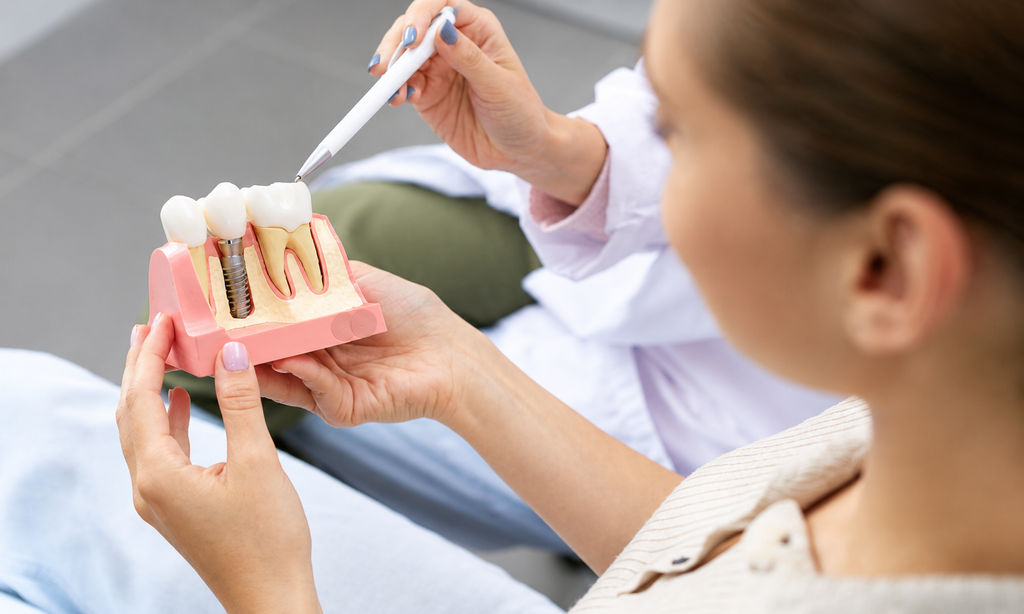
    Dentist explaining a dental implant model with the titanium post, abutment, and crown to a patient

    A dental implant replaces a missing tooth in three parts. A small titanium post takes the place of the tooth’s root, sitting inside your jawbone. An abutment connects that post to the visible part of the tooth. And a custom crown sits on top, matched to your natural teeth in shape and color.

    Titanium works so well here because your jawbone actually fuses to it over time, a process called osseointegration. That fusion is what makes an implant function like a real tooth root, rather than just sitting in place the way a denture does.

    Before the Procedure: The Consultation and Planning Stage

    Your dentist starts with a thorough exam, usually including X-rays or a 3D scan, to check your jawbone density and the exact position of nerves and sinuses nearby. This step matters more than people expect. Bone quality varies from person to person, and it directly affects whether you’re a straightforward candidate or need an extra step first.

    If your jawbone has thinned out, often from a tooth that’s been missing for a while, your dentist may recommend a bone graft before placing the implant. A graft adds several months to the overall timeline, since the grafted bone needs to heal and strengthen before it can properly support an implant. Not everyone needs one. Many patients move straight to implant placement.

    At this stage, your dentist also maps out how many implants you need. A single missing tooth needs just one. Several missing teeth in a row, or a full arch, might use a bridge supported by two or more implants instead of replacing every single tooth individually, which keeps the procedure and the cost more manageable.

    During the Procedure: What Implant Surgery Actually Involves

    The placement itself is a minor oral surgery, done under local anesthesia, so you stay comfortable and awake throughout. Your dentist makes a small opening in the gum, places the titanium post directly into the jawbone, and closes the site. A single implant typically takes one to two hours.

    Most people describe the procedure as far less dramatic than they expected. The anesthesia handles the discomfort during the surgery itself, and any soreness afterward responds well to standard pain relief, similar to what you’d feel after a tooth extraction.

    Once the post is in place, the waiting begins. Osseointegration, the bone fusing to the implant, takes roughly three to six months. Lower jaw implants tend to integrate a bit faster than upper jaw ones, simply because the bone density differs between the two. This phase can’t be rushed. It’s biological, not something a dentist can speed along, and it’s the single reason the full implant process takes months rather than weeks.

    Once your dentist confirms the implant has fully integrated, a second short procedure attaches the abutment. From there, your dentist takes an impression to create your custom crown, which gets fitted and attached a few weeks later.

    After the Procedure: Healing Week by Week

    The first 24 to 48 hours bring the most noticeable swelling and tenderness, similar to recovering from an extraction. Rest, a cold compress, and the pain relief your dentist recommends keep this manageable.

    The first week calls for soft foods and gentle care around the surgical site. Most patients return to normal daily activities within a few days, though strenuous exercise usually waits until the initial swelling settles.

    Weeks two through six cover the early soft-tissue healing around the implant. Good oral hygiene matters enormously here, since keeping the area clean protects against infection while everything underneath continues fusing.

    Months two through six are mostly uneventful from your side. Osseointegration happens quietly in the background, and your dentist checks in periodically to confirm everything’s progressing as expected.

    After full integration, the abutment and crown placement finish the process, and you’re left with a tooth that looks, feels, and functions like the one it replaced.

    Is an Implant Right for You?

    Good candidates generally have healthy gums, enough jawbone to support the implant (or the willingness to graft first), and no uncontrolled conditions that would slow healing, like unmanaged diabetes or active gum disease. Smoking also significantly affects healing and integration, so your dentist will likely discuss this directly if it applies to you.

    Age alone rarely rules someone out. What matters more is overall oral and bone health, which your dentist evaluates properly during that first consultation rather than guessing from general assumptions.

    Implant vs. Bridge: A Quick Comparison

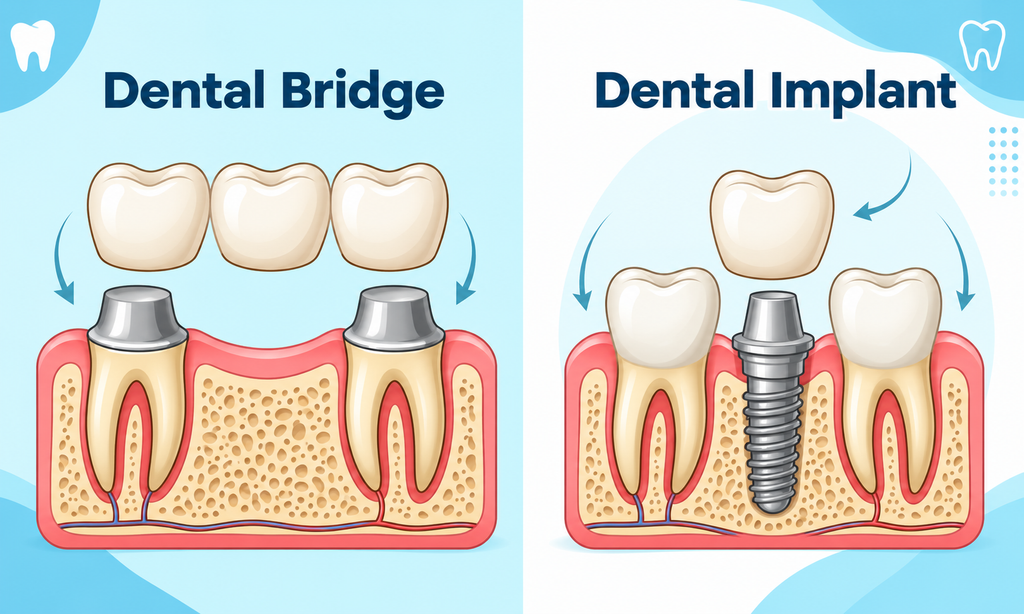
    Diagram comparing a dental bridge anchored to filed-down teeth versus a dental implant placed directly in the jawbone

    A traditional bridge replaces a missing tooth by anchoring a false tooth to the healthy teeth on either side of the gap, which means grinding down those neighboring teeth to support it. An implant doesn’t touch your surrounding teeth at all. It stands on its own, supported directly by your jawbone.

    Bridges cost less upfront and involve no surgery, which makes them appealing for some patients. Implants tend to last longer, preserve your jawbone density (since chewing pressure on the implant keeps stimulating the bone the way a natural root would), and avoid putting extra strain on healthy neighboring teeth. Your dentist can walk you through which makes more sense for your specific situation.

    If a fixed option isn’t the right fit for your situation, dentures remain a strong, flexible alternative worth discussing with your dentist.

    Frequently Asked Questions

    Q: How much does a dental implant cost?

    A: Cost varies depending on how many implants you need, whether a bone graft comes first, and the type of crown or bridge attached at the end. A single implant consultation gives you a clear, personalized estimate rather than a generic number, since every case differs.

    Q: Are dental implants painful?

    A: The surgery itself happens under local anesthesia, so you won’t feel pain during placement. Afterward, most patients describe mild to moderate soreness for a few days, similar to a tooth extraction, manageable with standard pain relief.

    Q: How long does the whole process take?

    A: From consultation to a finished crown, the full process usually spans three to eight months, mostly because osseointegration can’t be rushed. The appointments themselves take up a small fraction of that time.

    Q: Can I get an implant if I’ve been missing a tooth for years?

    A: Often, yes. Long-term tooth loss can lead to bone thinning in that area, which sometimes means a bone graft comes first. Your dentist evaluates this directly with imaging rather than assuming based on how long the tooth’s been gone.

    Q: What happens if I don’t replace a missing tooth at all?

    A: Neighboring teeth gradually shift into the gap, your bite can change, and the jawbone underneath the missing tooth slowly loses density from lack of stimulation. Replacing the tooth, whether with an implant or another option, prevents that chain reaction.

    Dental Implants at C Dental Clinic

    At C Dental Clinic in Al Nahda, Sharjah, every implant case starts with a proper evaluation of your jawbone, gum health, and overall dental history, since the right approach genuinely depends on your specific situation rather than a one-size-fits-all plan. Whether you need a single implant or a full arch, we walk you through each stage clearly before anything begins.

    👉 Book a consultation at C Dental Clinic to find out if dental implants are right for you.

    References

    1. Cleveland Clinic — Dental Implants: Procedure, Recovery, and Benefits
    2. Mayo Clinic — Dental Implant Surgery: What You Can Expect
    3. American Academy of Implant Dentistry — Dental Implant FAQs