

A missing tooth changes more than your smile. It changes how you chew, how your other teeth shift over time, and sometimes how confident you feel talking to someone up close. Dental implants exist to solve that problem properly, not just cover it up, and they’ve become the option most dentists recommend when a tooth can’t be saved.
Still, “implant” is a word that carries a lot of anxiety. People imagine a long, painful surgery and months of uncertainty. The reality looks quite different once you understand what actually happens at each stage.
What a Dental Implant Actually Is

A dental implant replaces a missing tooth in three parts. A small titanium post takes the place of the tooth’s root, sitting inside your jawbone. An abutment connects that post to the visible part of the tooth. And a custom crown sits on top, matched to your natural teeth in shape and color.
Titanium works so well here because your jawbone actually fuses to it over time, a process called osseointegration. That fusion is what makes an implant function like a real tooth root, rather than just sitting in place the way a denture does.
Before the Procedure: The Consultation and Planning Stage
Your dentist starts with a thorough exam, usually including X-rays or a 3D scan, to check your jawbone density and the exact position of nerves and sinuses nearby. This step matters more than people expect. Bone quality varies from person to person, and it directly affects whether you’re a straightforward candidate or need an extra step first.
If your jawbone has thinned out, often from a tooth that’s been missing for a while, your dentist may recommend a bone graft before placing the implant. A graft adds several months to the overall timeline, since the grafted bone needs to heal and strengthen before it can properly support an implant. Not everyone needs one. Many patients move straight to implant placement.
At this stage, your dentist also maps out how many implants you need. A single missing tooth needs just one. Several missing teeth in a row, or a full arch, might use a bridge supported by two or more implants instead of replacing every single tooth individually, which keeps the procedure and the cost more manageable.
During the Procedure: What Implant Surgery Actually Involves
The placement itself is a minor oral surgery, done under local anesthesia, so you stay comfortable and awake throughout. Your dentist makes a small opening in the gum, places the titanium post directly into the jawbone, and closes the site. A single implant typically takes one to two hours.
Most people describe the procedure as far less dramatic than they expected. The anesthesia handles the discomfort during the surgery itself, and any soreness afterward responds well to standard pain relief, similar to what you’d feel after a tooth extraction.
Once the post is in place, the waiting begins. Osseointegration, the bone fusing to the implant, takes roughly three to six months. Lower jaw implants tend to integrate a bit faster than upper jaw ones, simply because the bone density differs between the two. This phase can’t be rushed. It’s biological, not something a dentist can speed along, and it’s the single reason the full implant process takes months rather than weeks.
Once your dentist confirms the implant has fully integrated, a second short procedure attaches the abutment. From there, your dentist takes an impression to create your custom crown, which gets fitted and attached a few weeks later.
After the Procedure: Healing Week by Week
The first 24 to 48 hours bring the most noticeable swelling and tenderness, similar to recovering from an extraction. Rest, a cold compress, and the pain relief your dentist recommends keep this manageable.
The first week calls for soft foods and gentle care around the surgical site. Most patients return to normal daily activities within a few days, though strenuous exercise usually waits until the initial swelling settles.
Weeks two through six cover the early soft-tissue healing around the implant. Good oral hygiene matters enormously here, since keeping the area clean protects against infection while everything underneath continues fusing.
Months two through six are mostly uneventful from your side. Osseointegration happens quietly in the background, and your dentist checks in periodically to confirm everything’s progressing as expected.
After full integration, the abutment and crown placement finish the process, and you’re left with a tooth that looks, feels, and functions like the one it replaced.
Is an Implant Right for You?
Good candidates generally have healthy gums, enough jawbone to support the implant (or the willingness to graft first), and no uncontrolled conditions that would slow healing, like unmanaged diabetes or active gum disease. Smoking also significantly affects healing and integration, so your dentist will likely discuss this directly if it applies to you.
Age alone rarely rules someone out. What matters more is overall oral and bone health, which your dentist evaluates properly during that first consultation rather than guessing from general assumptions.
Implant vs. Bridge: A Quick Comparison
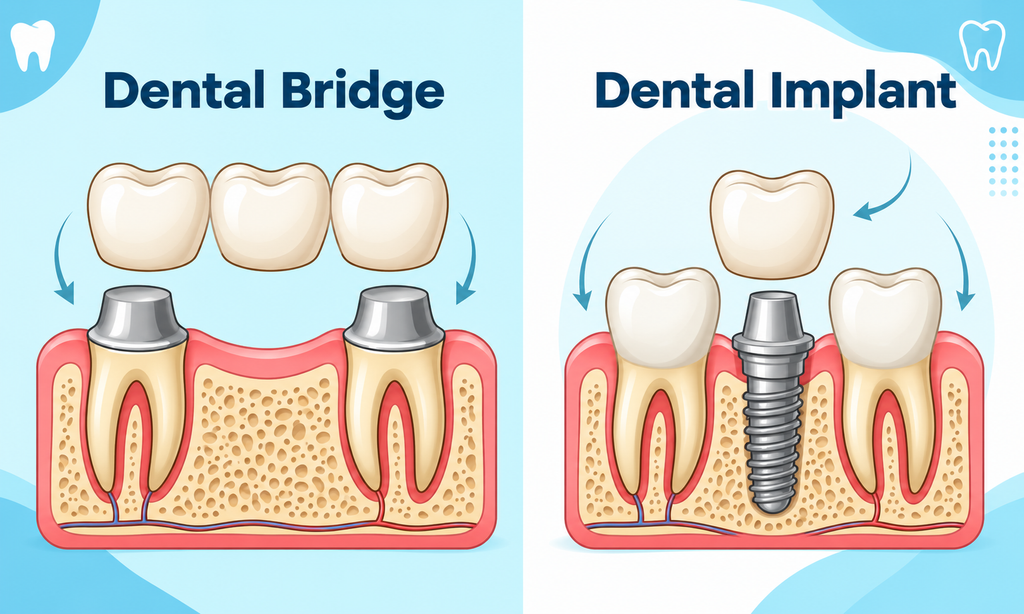
A traditional bridge replaces a missing tooth by anchoring a false tooth to the healthy teeth on either side of the gap, which means grinding down those neighboring teeth to support it. An implant doesn’t touch your surrounding teeth at all. It stands on its own, supported directly by your jawbone.
Bridges cost less upfront and involve no surgery, which makes them appealing for some patients. Implants tend to last longer, preserve your jawbone density (since chewing pressure on the implant keeps stimulating the bone the way a natural root would), and avoid putting extra strain on healthy neighboring teeth. Your dentist can walk you through which makes more sense for your specific situation.
If a fixed option isn’t the right fit for your situation, dentures remain a strong, flexible alternative worth discussing with your dentist.
Frequently Asked Questions
Q: How much does a dental implant cost?
A: Cost varies depending on how many implants you need, whether a bone graft comes first, and the type of crown or bridge attached at the end. A single implant consultation gives you a clear, personalized estimate rather than a generic number, since every case differs.
Q: Are dental implants painful?
A: The surgery itself happens under local anesthesia, so you won’t feel pain during placement. Afterward, most patients describe mild to moderate soreness for a few days, similar to a tooth extraction, manageable with standard pain relief.
Q: How long does the whole process take?
A: From consultation to a finished crown, the full process usually spans three to eight months, mostly because osseointegration can’t be rushed. The appointments themselves take up a small fraction of that time.
Q: Can I get an implant if I’ve been missing a tooth for years?
A: Often, yes. Long-term tooth loss can lead to bone thinning in that area, which sometimes means a bone graft comes first. Your dentist evaluates this directly with imaging rather than assuming based on how long the tooth’s been gone.
Q: What happens if I don’t replace a missing tooth at all?
A: Neighboring teeth gradually shift into the gap, your bite can change, and the jawbone underneath the missing tooth slowly loses density from lack of stimulation. Replacing the tooth, whether with an implant or another option, prevents that chain reaction.
Dental Implants at C Dental Clinic
At C Dental Clinic in Al Nahda, Sharjah, every implant case starts with a proper evaluation of your jawbone, gum health, and overall dental history, since the right approach genuinely depends on your specific situation rather than a one-size-fits-all plan. Whether you need a single implant or a full arch, we walk you through each stage clearly before anything begins.
👉 Book a consultation at C Dental Clinic to find out if dental implants are right for you.



Leave a Reply