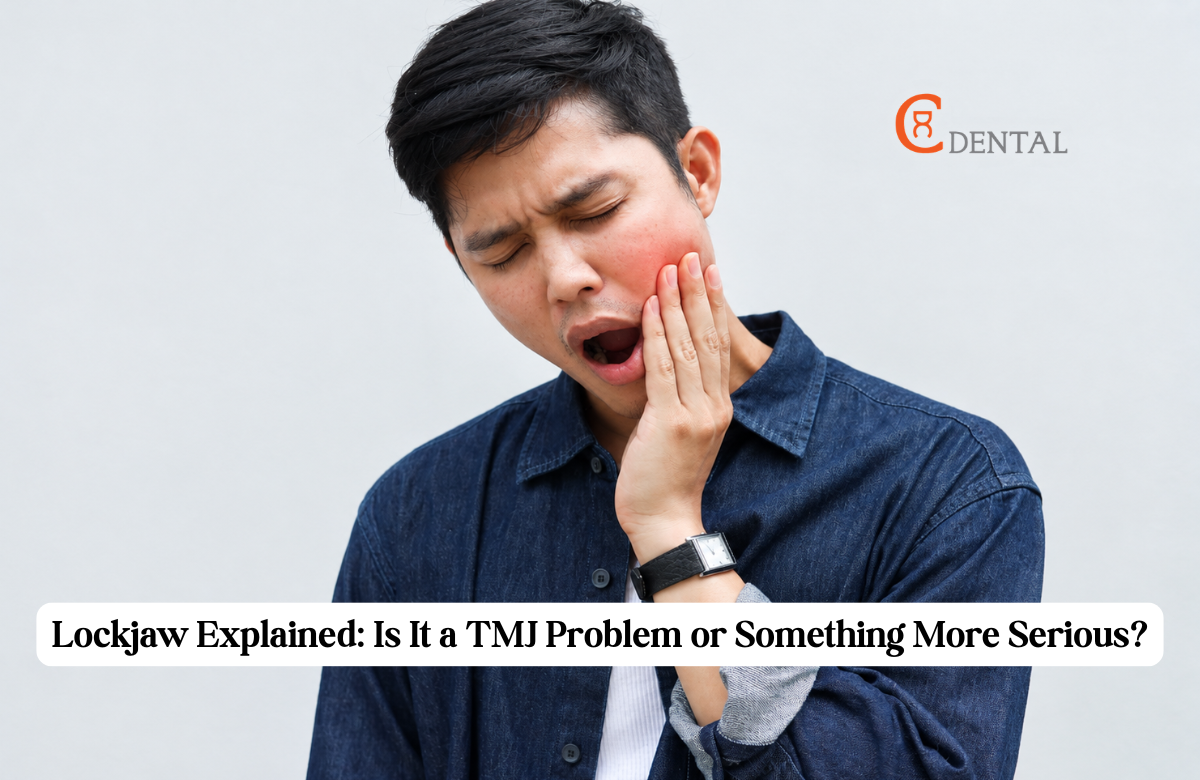

Few words in dentistry cause as much confusion as “lockjaw.” Someone types it into a search bar expecting a straightforward answer, and instead finds two completely different conditions sharing the same name, one that’s uncomfortable but harmless, and one that’s a genuine medical emergency. Not knowing which one applies to you is unsettling, and honestly, it should be. This is one of those topics worth getting exactly right rather than guessing.
So let’s clear it up properly.
Lockjaw Actually Means Two Different Things-
Here’s the part that trips almost everyone up: “lockjaw” isn’t a single diagnosis. It’s an old, informal term that has ended up describing two unrelated conditions, and the word itself gives no clue which one you’re dealing with.
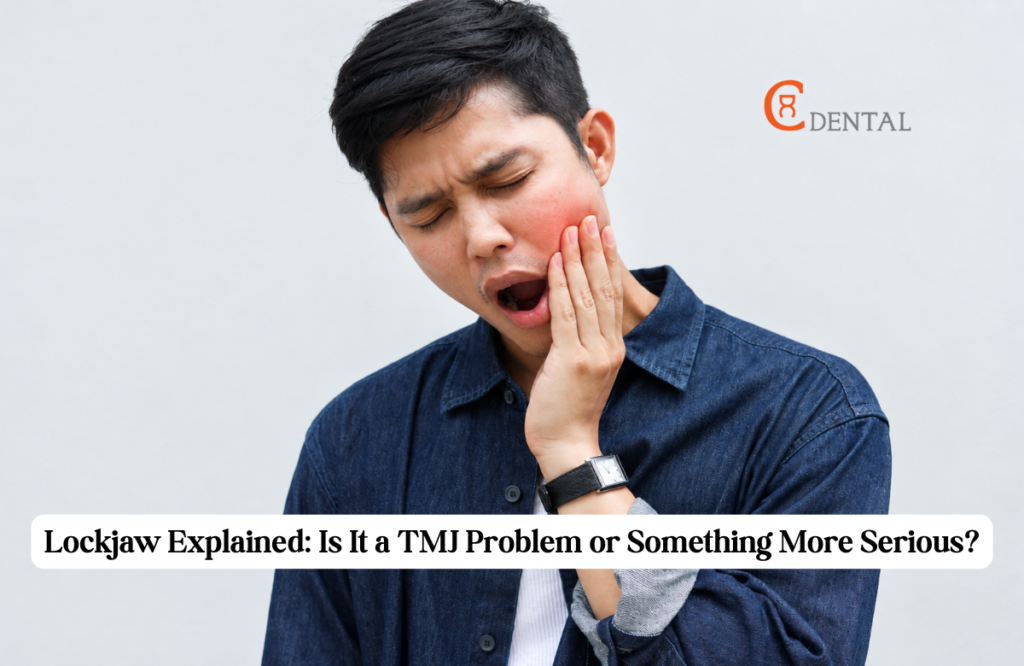
The first, and far more common, is trismus. This is when the muscles around your jaw joint tighten or spasm to the point where you can’t open your mouth fully, sometimes barely at all. It’s usually linked to the temporomandibular joint (TMJ), dental procedures, jaw injury, or muscle strain. It’s painful and frustrating, but it is not life-threatening.
The second is tetanus, a bacterial infection that historically gave “lockjaw” its name in the first place. Tetanus causes severe, whole-body muscle spasms, starting in the jaw and neck and potentially spreading further. This one is a medical emergency, and it has nothing to do with your teeth or TMJ.
Both get called lockjaw. Only one belongs in a conversation with your dentist. Telling them apart matters, so let’s go through each one properly.
TMJ-Related Lockjaw (Trismus): What Causes It
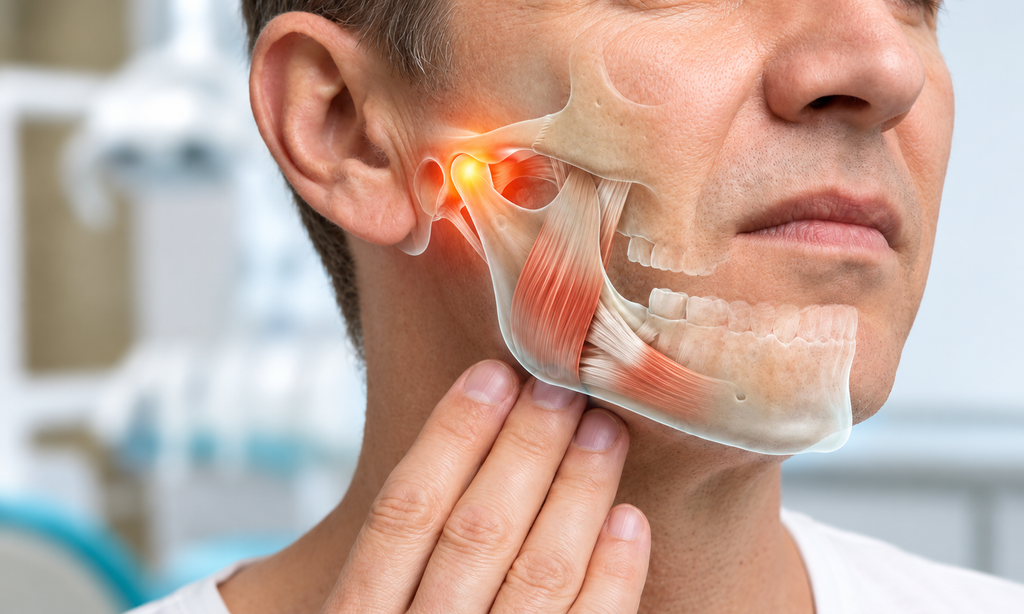
Trismus happens when the muscles responsible for opening and closing your jaw go into spasm or become too tight to function normally. A healthy mouth typically opens somewhere between 40 and 60 millimeters. With trismus, that range often drops well below 35 millimeters, sometimes far less.
A number of things can trigger it:
TMJ disorder. Problems with the joint itself, including a displaced disc that physically blocks the jaw from opening fully, are among the most common causes of trismus.
Dental procedures. This is worth knowing specifically if you’re a dental patient. Trismus can follow wisdom tooth extractions, long or difficult procedures where the jaw was held open for an extended time, or occasionally an injection of local anaesthetic that irritates nearby muscle tissue. It’s a recognized, temporary side effect rather than a sign anything went wrong.
Jaw trauma. A blow to the face or jaw, or an injury from a fall or accident, can cause the surrounding muscles to tighten protectively.
Muscle overuse or strain. Prolonged clenching, teeth grinding, or even a wide yawn in an awkward position can occasionally trigger a temporary spasm.
Infections near the jaw. Dental infections, mumps, or tonsillitis can sometimes cause enough localized inflammation to restrict jaw movement.
Radiation therapy. For patients who’ve had radiation to the head or neck area, trismus is a well-documented and fairly common side effect, sometimes appearing months after treatment ends.
Symptoms of TMJ-Related Trismus
Trismus tends to present in a fairly consistent way:
- Difficulty opening your mouth fully, or being unable to open it at all in more severe cases
- Pain or tenderness around the jaw joint, especially when trying to open wider
- Jaw stiffness that may ease slightly with gentle movement, then return
- Trouble chewing or swallowing certain foods
- A history of jaw clicking or popping before the locking began, which often points toward a TMJ disc issue specifically
- Discomfort that stays localized to the jaw and face, without spreading to the rest of the body
If your jaw feels stuck, sore, and limited to that one area, this is almost always what you’re dealing with, and it’s very manageable.
Tetanus Lockjaw: Why It’s a Completely Different Situation
Tetanus is caused by a bacterial toxin, usually entering the body through a wound, cut, or puncture, particularly one that’s deep or contaminated with soil or rust. It has nothing to do with dental work or TMJ health. Thanks to widespread vaccination, it’s now uncommon in places with good healthcare access, but it hasn’t disappeared, and it remains genuinely dangerous when it does occur.
What sets tetanus apart from TMJ-related trismus is that the muscle spasms don’t stay in the jaw. Warning signs include:
- Jaw stiffness that progresses quickly and severely
- Spasms spreading to the neck, chest, back, or stomach
- Difficulty swallowing alongside the jaw symptoms
- Muscle rigidity or spasms triggered by light, sound, or touch
- Fever, sweating, or a noticeably elevated heart rate
- A stiff, unusual facial expression sometimes described as a forced smile
If any of this sounds like what you’re experiencing, especially alongside a recent wound, cut, or injury, particularly if your tetanus vaccination isn’t up to date, this is not something to wait out or treat at home. It requires emergency medical care immediately, not a dental appointment.
How to Tell Them Apart
A simple way to think about it: TMJ-related lockjaw stays local. It’s confined to your jaw, face, and sometimes your neck, and while it’s uncomfortable, you generally still feel like yourself otherwise. Tetanus spreads. It moves beyond the jaw, comes with symptoms like fever and full-body muscle stiffness, and tends to get noticeably worse over hours or days rather than staying the same.
If you’re ever unsure, treat it as urgent and get evaluated rather than guessing. A doctor or emergency room can rule out tetanus quickly, while a dentist can properly diagnose and treat TMJ-related trismus.
Treating TMJ-Related Lockjaw
The reassuring part is that trismus, once confirmed as TMJ or muscle-related rather than tetanus, responds well to fairly conservative treatment:
- Gentle jaw stretching exercises, often guided by a dentist or physical therapist, to gradually restore range of motion
- Moist heat applied to the jaw to relax tight muscles
- Anti-inflammatory medication or, in some cases, a short course of muscle relaxants
- A custom night guard or oral appliance if grinding or clenching is contributing to the problem
- Addressing the underlying cause directly, whether that’s a TMJ disc issue, healing from a recent dental procedure, or an infection that needs treatment
Most cases improve steadily over days to a couple of weeks with the right approach. It’s not something you have to simply push through on your own.
If It Happened After a Dental Procedure
If your jaw feels stiff or limited to open shortly after a dental appointment, particularly after a longer procedure or wisdom tooth removal, try not to panic. This is a recognized, temporary effect in some patients, caused by the muscles being held in one position for an extended period. Gentle movement, warm compresses, and time usually resolve it. If it isn’t easing up after a few days, or the discomfort feels like it’s getting worse rather than better, that’s worth a follow-up call to your dentist.
Frequently Asked Questions
Q: Can lockjaw go away on its own?
A: Mild TMJ-related trismus sometimes eases with rest, gentle movement, and time. More persistent or painful cases benefit from a proper evaluation rather than waiting indefinitely, since addressing the underlying cause speeds up recovery considerably.
Q: Is lockjaw the same as a locked jaw joint?
A: They’re closely related but not identical. A “closed lock” specifically refers to a displaced TMJ disc physically blocking the joint, which is one particular cause of the broader symptom of trismus.
Q: How common is tetanus today?
A: It’s rare in places with routine vaccination access, but it hasn’t disappeared entirely, which is why deep wounds or punctures, especially if your tetanus booster isn’t current, are still worth taking seriously.
Q: Should I see a dentist or a doctor for jaw locking?
A: If the symptoms are confined to your jaw and face with no fever, spreading spasms, or recent wound involved, a dentist is the right first step. If there’s any sign it could be tetanus, emergency medical care comes first.
Q: Can stress cause my jaw to lock?
A: Yes, indirectly. Stress-related clenching and grinding put sustained strain on the jaw muscles and joint, which can contribute to episodes of trismus over time.
TMJ and Jaw Care at C Dental Clinic

At C Dental Clinic in Al Nahda, Sharjah, jaw locking and TMJ-related discomfort are evaluated properly before any treatment is recommended, since the right approach depends entirely on what’s actually causing it. If your jaw has been feeling stuck, sore, or limited after a recent dental procedure or otherwise, it’s worth having it looked at rather than working around it.
👉 Book a consultation at C Dental Clinic if your jaw pain or stiffness isn’t improving.
Leave a Reply