

Hearing that your child needs a “baby root canal” tends to trigger two reactions at once: relief that the tooth can be saved, and confusion about what the procedure actually involves. To make it more confusing, dentists use two different terms, pulpotomy and pulpectomy, somewhat interchangeably in casual conversation, even though they’re genuinely different procedures.
Understanding the difference helps you know what to expect, and helps you ask your dentist the right questions before treatment.
Why Baby Teeth Sometimes Need This at All
Baby teeth have proportionally larger pulp chambers than adult teeth, the soft inner tissue containing nerves and blood vessels. That makes them more vulnerable once decay or damage reaches that inner layer. When a cavity goes untreated, or a tooth gets damaged from an injury, bacteria can reach the pulp and cause infection or inflammation.
At that point, your dentist has a decision to make: treat the pulp to save the tooth, or extract it. In most cases, saving the baby tooth is the better outcome, since baby teeth hold space for permanent teeth, guide them into proper position, and support normal chewing and speech development until they naturally fall out.
A pediatric dentist is specially trained to assess children’s developing teeth and recommend appropriate treatments, including pulpotomy and pulpectomy.
What a Pulpotomy Actually Is
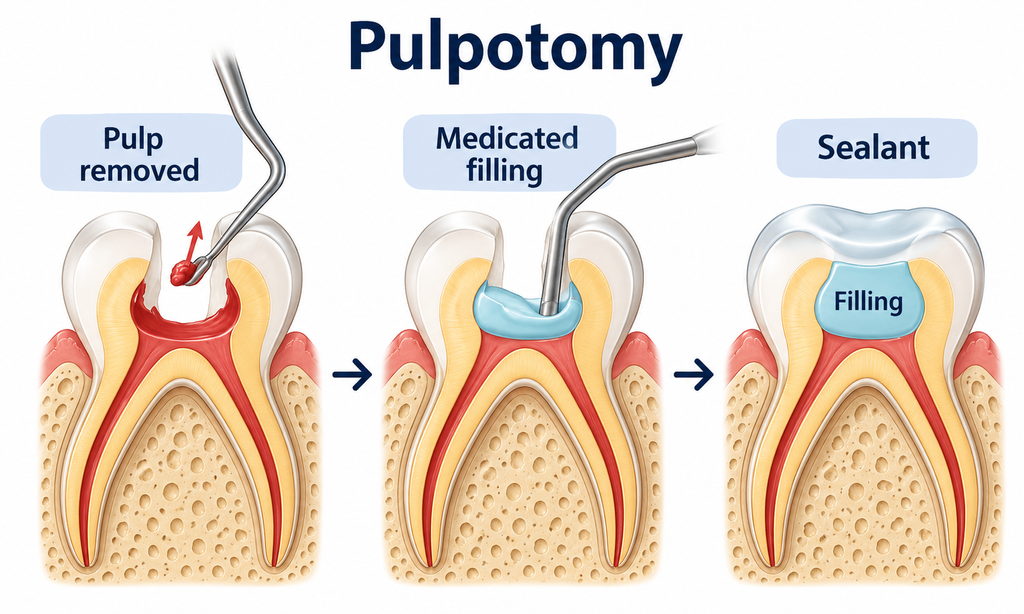
A pulpotomy treats only the upper portion of the pulp, the part inside the crown of the tooth. Your dentist removes the damaged or infected tissue from that top section, leaves the healthy pulp in the root intact, and seals the area with a medicated material to protect what remains. A stainless steel crown or filling usually finishes the tooth off.
This is the more conservative option, and it works well when the infection or damage hasn’t reached down into the root canals yet. It’s most commonly done on baby molars, which have more pulp tissue and a higher chance of this kind of exposure.
What a Pulpectomy Actually Is
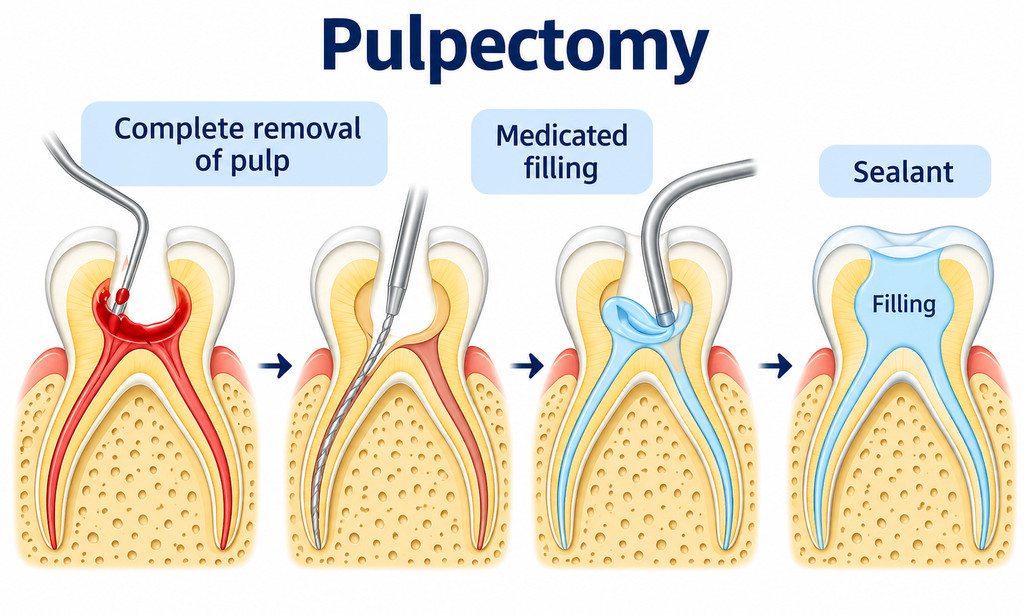
A pulpectomy goes further. If the infection has spread into the root canals themselves, or the pulp throughout the entire tooth is too damaged to leave any of it in place, your dentist removes all of the pulp, crown and root both. The canals get cleaned, disinfected, and filled with a material designed specifically for baby teeth, since it needs to resorb naturally as the tooth eventually falls out on its own. A crown typically completes the restoration here too.
Essentially, a pulpectomy functions like a full root canal, just adapted for a tooth that’s going to exfoliate eventually rather than stay in your child’s mouth forever.
The Core Difference, Simply Put
| Pulpotomy | Pulpectomy | |
|---|---|---|
| What’s removed | Pulp from the crown only | Pulp from the crown and the roots |
| When it’s used | Partial infection, healthy pulp remains in the root | Infection has spread through the entire tooth |
| Procedure extent | Less invasive, shorter | More involved, similar to an adult root canal |
| Goal | Save the tooth, preserve healthy tissue below | Save the tooth despite more extensive damage |
Both procedures share the same underlying goal: save the baby tooth rather than extract it, whenever that’s a realistic option.
How Your Dentist Decides Which One Your Child Needs
This isn’t guesswork. Your dentist bases the decision on a combination of factors:
- Symptoms. Mild, occasional sensitivity points toward a more contained problem. Persistent pain, swelling, or a visible gum abscess suggests the infection has progressed further.
- X-rays. Imaging shows exactly how far decay or infection has spread, including whether it’s reached the root canals.
- Bleeding during the procedure. If your dentist starts a pulpotomy and finds excessive bleeding or clearly infected tissue in the root canals once the crown portion is treated, that’s often a sign the plan needs to shift toward a full pulpectomy instead.
- Overall tooth condition. Enough healthy tooth structure needs to remain to support a restoration afterward, regardless of which procedure is used.
Sometimes a dentist won’t know for certain which procedure is needed until partway through treatment, which is completely normal and part of why these decisions happen in real time rather than purely from an X-ray beforehand.
What to Expect Afterward
Recovery from both procedures tends to be quick. Mild soreness for a day or two is normal, usually manageable with the pain relief your dentist recommends. Most children return to normal eating and activities within a day or so, and both procedures are generally well tolerated even in younger kids.
The restored tooth, whether finished with a filling or a stainless steel crown, functions normally afterward, letting your child chew, speak, and smile without the issue that brought them in.
What Happens If You Skip Treatment Entirely
It’s worth understanding why extraction isn’t automatically the simpler choice. Pulling a baby tooth too early can let neighboring teeth drift into the empty space, which sometimes crowds or misaligns the permanent tooth trying to come in underneath. It can also affect your child’s ability to chew properly on that side and, in some cases, impact speech development if front teeth are involved. A pulpotomy or pulpectomy, when the tooth can realistically be saved, generally supports better long-term outcomes than early extraction.
Frequently Asked Questions
Q: Is a pulpotomy or pulpectomy painful for my child?
A: Both are done under local anesthesia, so your child shouldn’t feel pain during the procedure. Mild soreness afterward is normal and typically resolves within a day or two.
Q: Will my child need a crown afterward either way?
A: Often, yes. Baby teeth treated with either procedure usually need a crown or filling to restore strength and function, since the tooth structure has been weakened by the decay or infection in the first place.
Q: Can a pulpotomy turn into a pulpectomy during the same visit?
A: Yes, this happens fairly often. If your dentist finds more extensive infection than expected once treatment begins, the plan may shift to a pulpectomy in the same appointment to properly address it.
Q: Does the filling material in a pulpectomy stay in permanently?
A: No. The material used in a baby tooth pulpectomy is specifically designed to resorb naturally as the tooth eventually loosens and falls out, unlike the permanent material used in an adult root canal.
Q: How do I know if my child’s tooth pain means they need one of these procedures?
A: Persistent pain, swelling, a visible bump on the gum, or sensitivity that doesn’t improve are all signs worth having checked. An exam and X-ray give your dentist the clearest picture rather than guessing from symptoms alone.

Pediatric Pulp Treatment at C Dental Clinic
At C Dental Clinic in Al Nahda, Sharjah, every pulpotomy or pulpectomy decision starts with a proper exam and X-ray, so your child gets exactly the treatment their tooth actually needs, nothing more invasive than necessary. Our pediatric dentistry team walks you through the plan clearly at every step.
👉 Book a consultation at C Dental Clinic if your child is dealing with tooth pain or a dental injury.
References
- Cleveland Clinic — Pulpotomy vs. Pulpectomy: What’s the Difference?
- American Academy of Pediatric Dentistry — Pulp Therapy for Primary Teeth
- Colgate Oral Care — Baby Root Canals: What Parents Should Know



Leave a Reply